Blogs
Pellet Gun vs BB Gun: What’s the Difference and Which Is Right for You?
Jul
Walk into any airgun retailer and you’ll hear “pellet gun” and “BB gun” used almost interchangeably — but they’re not the same thing, and the difference matters for accuracy, power, and what you’ll actually use the gun for. This guide breaks down exactly what separates the two, how powerful each one really is, what pellet guns are commonly used for, and answers the safety questions people search for most: can they hurt you, and just how lethal are they?
What Is a Pellet Gun Used For?
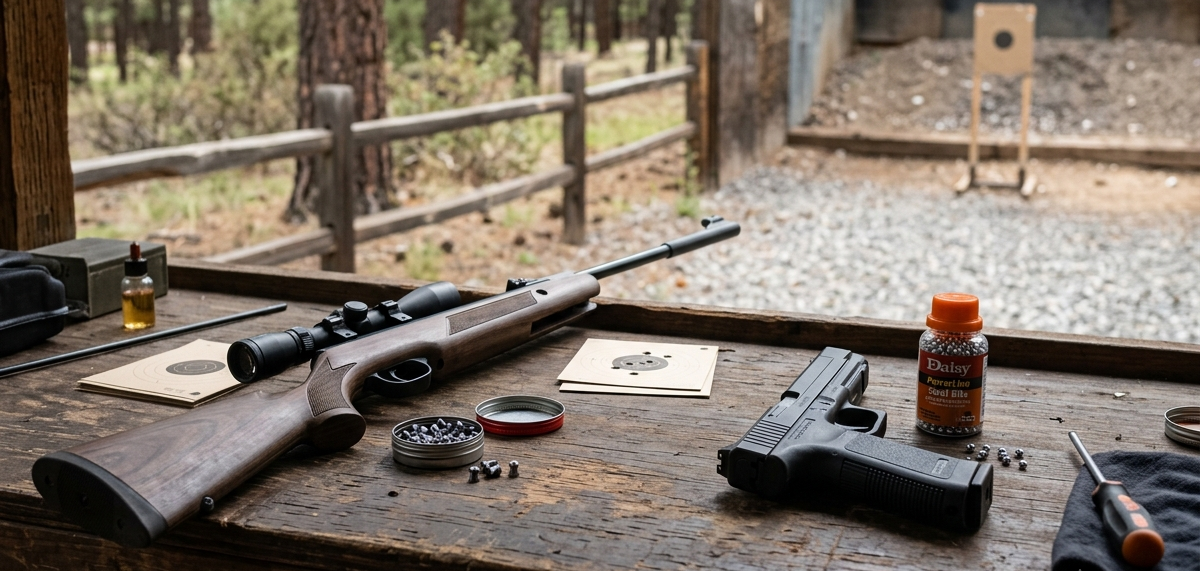
A pellet gun is an air-powered gun that fires diabolo-shaped (waisted, skirted) pellets, usually made of lead or a lead alloy, through a rifled barrel. That rifling spins the pellet in flight, similar to a firearm bullet, which gives it far better accuracy over distance than a smooth-bore BB gun.
Pellet guns are used for a wide range of practical and recreational purposes, including:
- Pest control — removing rodents, birds, and small nuisance animals from gardens, farms, and warehouses
- Target shooting and plinking — informal backyard shooting at cans, targets, and other objects
- Small game hunting — rabbits, squirrels, and similarly sized game, particularly with .22 calibre and larger pellets
- Competitive and Olympic-style shooting — 10-metre air rifle and air pistol disciplines use precision pellet guns
- Training new shooters — lower recoil and noise make pellet guns a common stepping stone before firearm training
- Home and property deterrence — used by some as a lower-cost deterrent against pests or opportunistic intruders (see limitations below)
The rifled barrel and heavier, aerodynamic pellet design are what set pellet guns apart in terms of use case — they’re built for precision at range, not just plinking.
Pellet Gun vs BB Gun: The Core Differences
| Feature | Pellet Gun | BB Gun |
| Projectile shape | Diabolo (waisted/skirted), improves flight stability | Round steel or lead ball |
| Barrel type | Rifled (spins projectile for accuracy) | Smoothbore (no spin, less stable flight) |
| Typical calibre | .177, .22, .25, .30+ | 4.5mm / .177 (steel BB) |
| Effective accurate range | Up to 50+ metres (varies by power/skill) | Roughly 10–20 metres before accuracy drops sharply |
| Common material | Lead or lead-alloy | Steel (sometimes zinc- or copper-plated) |
| Typical use case | Pest control, hunting, target shooting, competition | Casual plinking, target practice, some tactical/replica training |
| Ricochet risk | Lower — softer lead deforms on impact | Higher — hard steel balls bounce off surfaces |
The practical takeaway: if accuracy and stopping power at distance matter — pest control, small game, or serious target shooting — a pellet gun is the better tool. If you want a cheap, simple gun for casual backyard plinking or basic trigger-time practice, a BB gun is often sufficient and more affordable to run.
How Powerful Is a Pellet Gun?
Power in the airgun world is measured by muzzle velocity (feet per second, or fps) and muzzle energy (foot-pounds, or joules) — velocity alone doesn’t tell the full story, since a lightweight pellet moving fast can carry less real stopping energy than a heavier pellet moving slower.
| Airgun Type | Typical Velocity | Typical Muzzle Energy |
| Entry-level .177 spring/break-barrel | 500 – 900 fps | 6 – 12 ft-lbs (approx. 8–16 joules) |
| Mid-range .177 spring or gas-piston | 900 – 1,200 fps | 12 – 20 ft-lbs |
| Entry PCP (.22 calibre) | 700 – 950 fps | 18 – 25 ft-lbs |
| .22 calibre tuned/regulated PCP | 750 – 1,000 fps | 25 – 47 ft-lbs |
| .25 – .30 calibre PCP | 800 – 1,000 fps | 40 – 100+ ft-lbs |
| Big-bore PCP (.45 – .72 calibre) | 700 – 1,025 fps | 150 – 1,500+ ft-lbs |
For context, most standard .177 pellet guns fall in the 6–20 ft-lbs range — plenty for pest control and target work, but well below firearm power levels, which typically start in the hundreds of foot-pounds for handguns alone.
What Is the Strongest Air Pellet Gun?
At the extreme end of the market, big-bore PCP (pre-charged pneumatic) air rifles dwarf standard pellet guns in raw power. The AEA Zeus, chambered in .72 calibre, is widely regarded as the most powerful commercially available air rifle, generating muzzle energy in the range of 1,500 ft-lbs — power levels that rival some firearm cartridges and are capable of taking large game animals.
Other notable high-power big-bore models include the AirForce Texan (.45 calibre, over 500 ft-lbs), the Hatsan Piledriver (.62 calibre, over 750 ft-lbs), and the Sam Yang Dragon Claw (.50 calibre, used for hunting large game internationally). These are specialist, high-cost rifles built for big-game hunting — a completely different category from the .177/.22 pellet guns most people picture when they hear “pellet gun.”
It’s worth noting that guns at this power level often exceed the airgun thresholds defined in South African firearms law (see our companion guide on pellet gun legality), meaning some big-bore PCP rifles may legally require a firearm licence depending on their exact calibre and muzzle energy rating.
What Is the Most Lethal Pellet Gun?
There’s no single “most lethal” model in a simple sense — lethality with any airgun depends on three factors working together: muzzle energy, pellet calibre/weight, and where the shot lands. That said, the big-bore PCP rifles referenced above (particularly .45 calibre and up, generating hundreds to over a thousand foot-pounds of energy) are unambiguously the most capable of causing fatal injury, and are treated by hunters as genuine big-game tools rather than recreational plinkers.
But lethality isn’t limited to big-bore guns. Medical literature is clear that even standard-power pellet and BB guns can cause fatal injuries, particularly to the eyes, neck, and chest, at relatively modest velocities. Research cited by the CDC has found that ocular penetration — a potentially fatal or blinding injury if it reaches the brain — can occur at velocities as low as roughly 130 ft-lbs of energy per second, far below what many mid-power pellet guns produce.
The U.S. Consumer Product Safety Commission has reported an average of around four deaths per year in the United States caused by BB and pellet guns — rare, but not zero, and disproportionately involving shots to the eye, neck, or chest where even modest energy can reach vital structures.
Can a Pellet Gun Hurt Someone? Do Pellet Guns Hurt?
Yes — unambiguously. This is one of the most persistent misconceptions around pellet guns: because they’re not legally classified as firearms in many countries, people assume they’re roughly as harmless as a toy. Medical and injury-surveillance data says otherwise.
| Question | What the Evidence Shows |
| Do pellet guns hurt? | Yes. At close range, pellets can cause everything from painful bruising and welts to deep puncture wounds, depending on power and clothing/skin coverage. |
| Do pellet guns do damage? | Yes. Documented cases include perforated organs (stomach, liver, pancreas), embedded pellets in soft tissue, and fractured bone at velocities as low as roughly 200 fps. |
| Can a pellet gun hurt someone? | Yes, seriously. Human skin can be broken by a projectile travelling at around 150 fps; injury risk escalates sharply above 200 fps, well within range of most pellet guns. |
| How much do pellet guns hurt? | This varies with shot placement, distance, and power — but medical reports describe injuries ranging from painful surface wounds to life-threatening internal trauma, particularly to the eyes, neck, and chest. |
Globally, air gun (BB and pellet gun) injuries are a genuine public health issue, not a fringe concern. Emergency-room surveillance data from the United States has recorded tens of thousands of air gun-related injuries annually, with children and teenagers accounting for the large majority of cases — most often from unsupervised or careless handling rather than deliberate misuse.
The eyes are consistently identified as the most vulnerable target: corneal abrasion, hyphema (bleeding inside the eye), traumatic cataracts, and in more severe cases globe rupture and permanent vision loss have all been documented from pellet and BB gun impacts. This is why eye protection is non-negotiable whenever a pellet gun is fired or nearby, regardless of the shooter’s age or experience level.
How Lethal Is a Pellet Gun? A Realistic Risk Summary
| Risk Factor | Detail |
| Skin penetration threshold | Roughly 150 fps — within the range of most entry-level pellet guns |
| Bone fracture risk | Begins to increase noticeably around 200 fps |
| Eye penetration / blinding injury | Can occur at very low relative energy, making the eyes the single most vulnerable target |
| Fatal injury (chest/neck/skull) | Rare but documented — deaths have resulted from shots to the heart, major blood vessels, and brain (via the eye socket) |
| Annual deaths (US data) | Approximately 4 per year, according to CPSC reporting — low probability, but non-zero and avoidable |
| Highest-risk group | Children and teenagers, particularly during unsupervised play — over 80% of documented air gun injuries fall in this age group |
The honest conclusion: a standard pellet gun is far less lethal than a firearm, but it is absolutely capable of causing serious, permanent, and occasionally fatal injury — especially to the eyes — and should always be handled with the same fundamental safety rules as a real gun: treat it as loaded, never point it at a person, wear eye protection, and never allow unsupervised use by minors.
Pellet Gun vs BB Gun: Which Is Right for You?
| Your Priority | Best Choice | Why |
| Pest control on a property | Pellet gun (.177 or .22) | Rifled barrel and diabolo pellets give the accuracy and knockdown needed for reliable, humane pest removal |
| Casual backyard plinking on a budget | BB gun | Cheaper ammunition, simpler mechanics, adequate for informal target practice at short range |
| Small game hunting | Pellet gun (.22 or larger) | BB guns lack the accuracy and knockdown power for ethical, humane hunting |
| Competitive/Olympic-style shooting | Pellet gun (precision PCP or spring) | Rifled accuracy and consistent pellet weight are essential for competition-grade groupings |
| Introducing a new/young shooter | BB gun or low-power pellet gun, always supervised | Lower cost of entry, but supervision and eye protection remain essential regardless of power level |
| Home/property deterrence | Higher-power pellet gun, used cautiously | More reliable at distance than a BB gun, though neither should be relied on as a primary defensive tool |
Key Takeaways
- Pellet guns use rifled barrels and diabolo-shaped pellets for accuracy; BB guns use smoothbore barrels and round steel BBs, sacrificing accuracy for simplicity and cost.
- Standard pellet guns typically generate 6–20 ft-lbs of energy — enough for pest control and target work, but far below firearm power levels.
- The most powerful air rifles (big-bore PCP models like the AEA Zeus) can generate over 1,000 ft-lbs, rivalling firearm cartridges and used for large-game hunting.
- Pellet and BB guns are genuinely capable of causing serious injury and, in rare cases, death — the eyes are the single most vulnerable target, and safety precautions should never be skipped.
- Choosing between a pellet gun and a BB gun comes down to your actual use case: accuracy and power favour pellet guns, while cost and simplicity favour BB guns for casual use.
Disclaimer: This article is for general informational purposes only. Power figures, velocities, and injury statistics are drawn from manufacturer specifications and publicly available medical/safety research, and can vary by model, region, and testing conditions. Always follow manufacturer safety guidance and applicable local laws when purchasing or using any airgun.