paintball guns
How Far And Fast Can Paintball Guns Shoot?
Jan
If you’re new to paintball or thinking about upgrading your gear, one of the most common questions you’ll hear is: how far can a paintball gun shoot, and how fast does it fire? These two factors—range and speed—play a major role in accuracy, safety, and overall gameplay experience when using first strike paintballs.
Unlike many myths that surround paintball markers, the reality is grounded in physics, field regulations, and practical limitations. Paintball guns are not designed to shoot endlessly far or at extreme speeds. Instead, they are carefully regulated to balance performance with player safety.
In this in-depth guide, we’ll explore how far paintball guns can shoot, how fast paintballs actually travel, what affects their range and velocity, and how these factors influence real-world gameplay. Rather than a simple checklist, this article explains the importance of understanding the paintball barrel and its effect on performance. why behind paintball performance so you can fully understand what to expect on the field.
Understanding Paintball Gun Speed and Range
Paintball guns, more accurately called paintball markers, operate using compressed gas or air to fire a gelatin ball filled with paint. Once the paintball leaves the barrel, it immediately begins to slow down due to air resistance and gravity.
This means that two key measurements matter in the context of play paintball:
- Muzzle velocity: how fast the paintball travels as it exits the barrel
- Effective range: how far the paintball can travel accurately enough to hit a target
While some players focus heavily on raw speed, experienced paintballers know that controlled velocity and accuracy matter far more than pushing limits.
How Fast Do Paintball Guns Shoot?
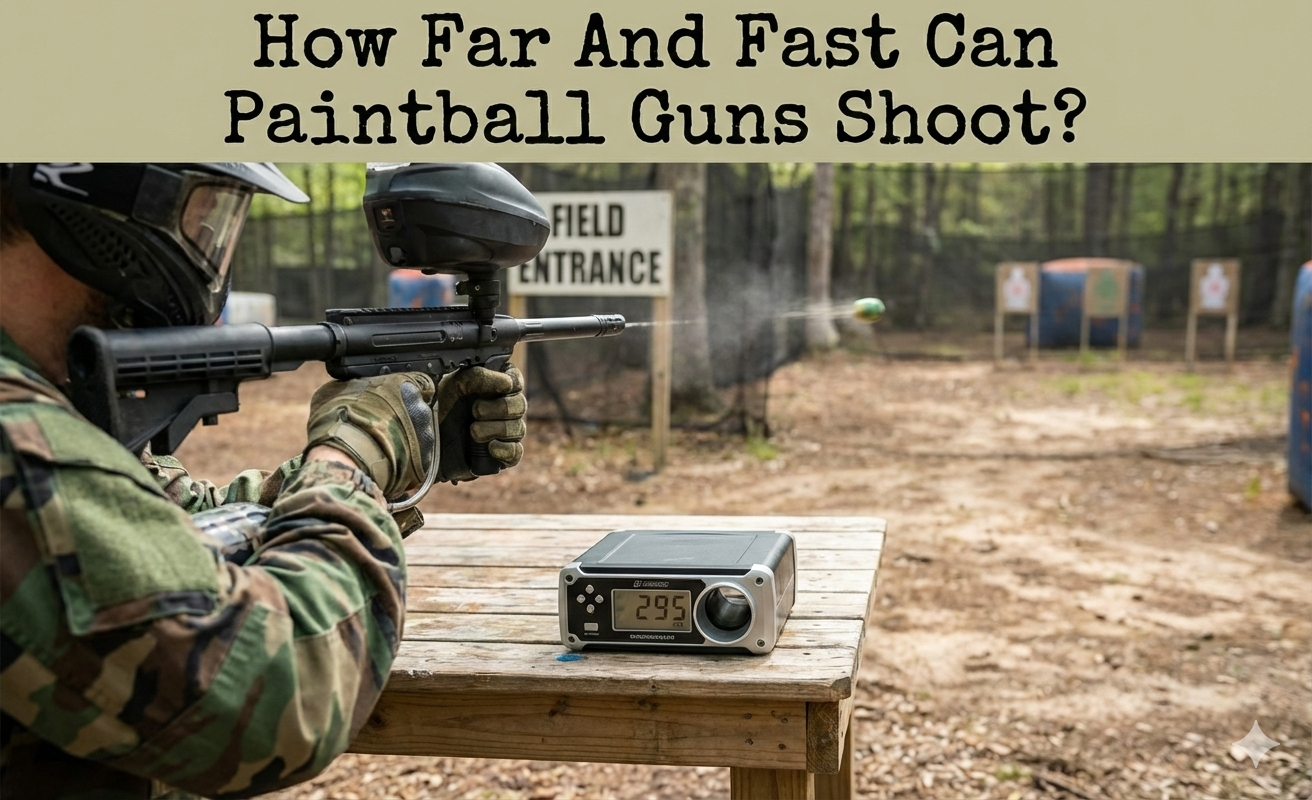
Most paintball guns fire paintballs at speeds between 260 and 300 feet per second (FPS). This range is not accidental—it is the industry standard enforced by paintball fields worldwide.
At approximately 300 FPS, paintballs can deliver significant impact, especially when using compressed air.
- The paintball travels fast enough to reach opponents at long distances
- The impact remains safe with proper protective gear
- Paintballs reliably break on contact, marking hits clearly
Speeds above this limit can become dangerous, increasing the risk of bruising or injury. That’s why virtually all professional and recreational paintball fields chronograph players’ markers before games begin.
In practical terms, 300 FPS translates to:
- Around 200 miles per hour at the moment of firing
- A paintball covering about 90 meters in one second
- A very short reaction window for opponents at close range
However, speed alone doesn’t tell the full story.
How Far Can a Paintball Gun Shoot?
Paintball guns can shoot paintballs surprisingly far under ideal conditions. In theory, a paintball fired at an upward angle could travel up to 300 feet (around 90 meters) before hitting the ground, the trajectory can be influenced by factors such as spin and air resistance.
But there’s an important distinction to make: maximum distance is not the same as effective range.
Maximum Distance vs Effective Range
A paintball may physically travel close to 300 feet, but beyond a certain point, it becomes wildly inaccurate and unlikely to break on impact. Most players consider the effective range of a paintball gun to be between 100 and 150 feet.
Within this distance:
- Paintballs fly relatively straight
- Accuracy is predictable
- Hits are likely to break on opponents
Beyond that range:
- Paintballs arc heavily
- Wind drastically affects trajectory
- Paintballs may bounce instead of breaking
This is why experienced players focus on positioning and movement rather than trying to shoot from extreme distances.
Why Paintballs Lose Speed So Quickly
Paintballs are large, lightweight, and filled with liquid paint. These characteristics make them very different from metal bullets or airgun pellets.
Once a paintball leaves the barrel:
- Air resistance immediately slows it down
- Gravity pulls it downward
- Minor imperfections in the ball affect its flight
Within just a few feet, the paintball begins losing velocity rapidly. By the time it reaches the far end of its effective range, it’s traveling much slower than when it left the marker.
This rapid deceleration is actually a safety feature, ensuring that long-distance hits are less painful and less likely to cause injury.
Does a Faster Paintball Gun Shoot Farther?
A common misconception is that increasing speed automatically increases range. In reality, this isn’t entirely true.
While a slightly higher velocity can extend range marginally, pushing speeds too high causes problems:
- Paintballs become unstable in flight
- Accuracy decreases
- Paint may break inside the barrel
- Safety risks increase
Most fields cap velocity at around 300 FPS because this speed represents the best balance between distance, accuracy, and safety. Beyond this point, performance gains are minimal while risks increase significantly.
What Affects Paintball Shooting Distance?
Several factors influence how far and how accurately a paintball gun can shoot in real gameplay.
Barrel Quality and Length
Contrary to popular belief, longer barrels don’t automatically increase speed. Instead, a quality barrel improves air efficiency and consistency, leading to better accuracy.
A smooth, well-matched barrel helps paintballs exit cleanly, reducing wobble and unpredictable curves.
Paintball Quality
High-quality paintballs are round, consistent in size, and have even shells, often featuring dimples for better aerodynamics. Poor-quality paintballs may be misshapen, causing erratic flight paths and reduced range.
Inconsistent paint is one of the biggest reasons players experience poor accuracy at distance.
Air Pressure Consistency
Markers that deliver consistent air pressure shot after shot perform better at range. Inconsistent pressure leads to varying speeds, making it harder to predict where paintballs will land.
Weather Conditions
Wind plays a massive role in paintball trajectory. Even a light breeze can push paintballs off course, especially at longer distances. Cold temperatures can also affect paintball brittleness and air efficiency.
How Fast Is Too Fast in Paintball?
Safety is a cornerstone of paintball, and speed limits exist for good reason. Paintballs fired above recommended velocities can cause:
- Severe bruising
- Broken skin
- Eye injuries if masks are compromised
That’s why fields strictly enforce chronograph checks. A marker firing above the limit will not be allowed on the field until adjusted.
Professional players don’t rely on higher speed to win games. Instead, they use:
- Better positioning is essential in play paintball to maximize the effective range of your shots.
- Smarter angles
- Controlled bursts of fire
- Team coordination
Speed without control offers no real advantage in paintball.
Does Faster Mean More Pain?
To a degree, yes—but only at close range. A paintball fired at 300 FPS from a short distance will sting more than one that has traveled 100 feet and slowed down significantly.
However, because paintballs lose speed rapidly, most long-range hits are far less painful than people expect. This is one reason why players often feel relieved after their first hit—it’s not nearly as bad as anticipated.
Also read : Beginner-friendly paintball markers for new players
How Range and Speed Affect Gameplay Strategy
Understanding how far and fast paintball guns shoot helps players make smarter decisions on the field.
Rather than spraying paint at distant targets, skilled players:
- Move closer to reduce paint drop
- Use cover to control engagement distance
- Fire in controlled bursts for accuracy
- Let opponents come into effective range
Paintball is as much about patience and timing as it is about firing speed or distance.
Can You Increase Paintball Range Safely?
While you can’t exceed field limits, you can optimize your setup to get the most out of allowed speeds.
Improving accuracy and effective range involves selecting the right paintball bore and ensuring proper spin.
- Using quality paintballs
- Keeping your marker well-maintained
- Matching barrel size to paint
- Practicing aim and movement
These improvements make far more difference than trying to push velocity limits.
The Reality Behind Paintball Myths
Many beginners assume paintball guns shoot extremely far and at dangerous speeds. In reality, paintball markers are carefully designed to stay within safe, predictable performance ranges.
Paintballs travel fast enough to be exciting but slow enough to remain safe, particularly when using co2 for propulsion. They can reach impressive distances, but only within a controlled and regulated environment.
This balance is what makes paintball both thrilling and accessible to players of all experience levels.
Conclusion: How Far and Fast Do Paintball Guns Really Shoot?
Paintball guns typically shoot paintballs at speeds of up to 300 FPS, which can be enhanced with a high-quality paintball barrel. up to 300 feet per second, with an effective range of around 100 to 150 feet. While paintballs can travel farther under ideal conditions, accuracy and consistency drop significantly beyond this range.
Speed and distance in paintball are carefully regulated to ensure fairness and safety. Rather than chasing maximum velocity, players get better results by understanding physics, improving accuracy, and playing strategically.
Once you understand how paintball guns truly perform, you’ll realize that success on the field comes from skill and awareness—not just how fast or far you can shoot.
Frequently Asked Questions (FAQ)
How far can a paintball gun shoot accurately?
Most paintball guns are accurate up to about 100–150 feet. Beyond this distance, paintballs lose stability and accuracy.
What is the maximum speed allowed for paintball guns?
Most fields allow a maximum speed of around 280–300 feet per second for safety reasons.
Can paintball guns shoot farther than airsoft guns?
Paintballs are heavier and larger, so they typically have a shorter effective range than airsoft pellets, but they hit with more visible impact.
Does increasing FPS improve accuracy?
No. Higher FPS often reduces accuracy due to paintball instability and increased air turbulence.
Why do paintballs curve or drop?
Paintballs are affected by gravity, air resistance, and imperfections in shape, causing them to arc and curve during flight, especially when spin is applied.
Is it dangerous to modify a paintball gun for higher speed?
Yes. Modifying a marker to exceed safe limits can cause injuries and will result in being banned from most paintball fields.